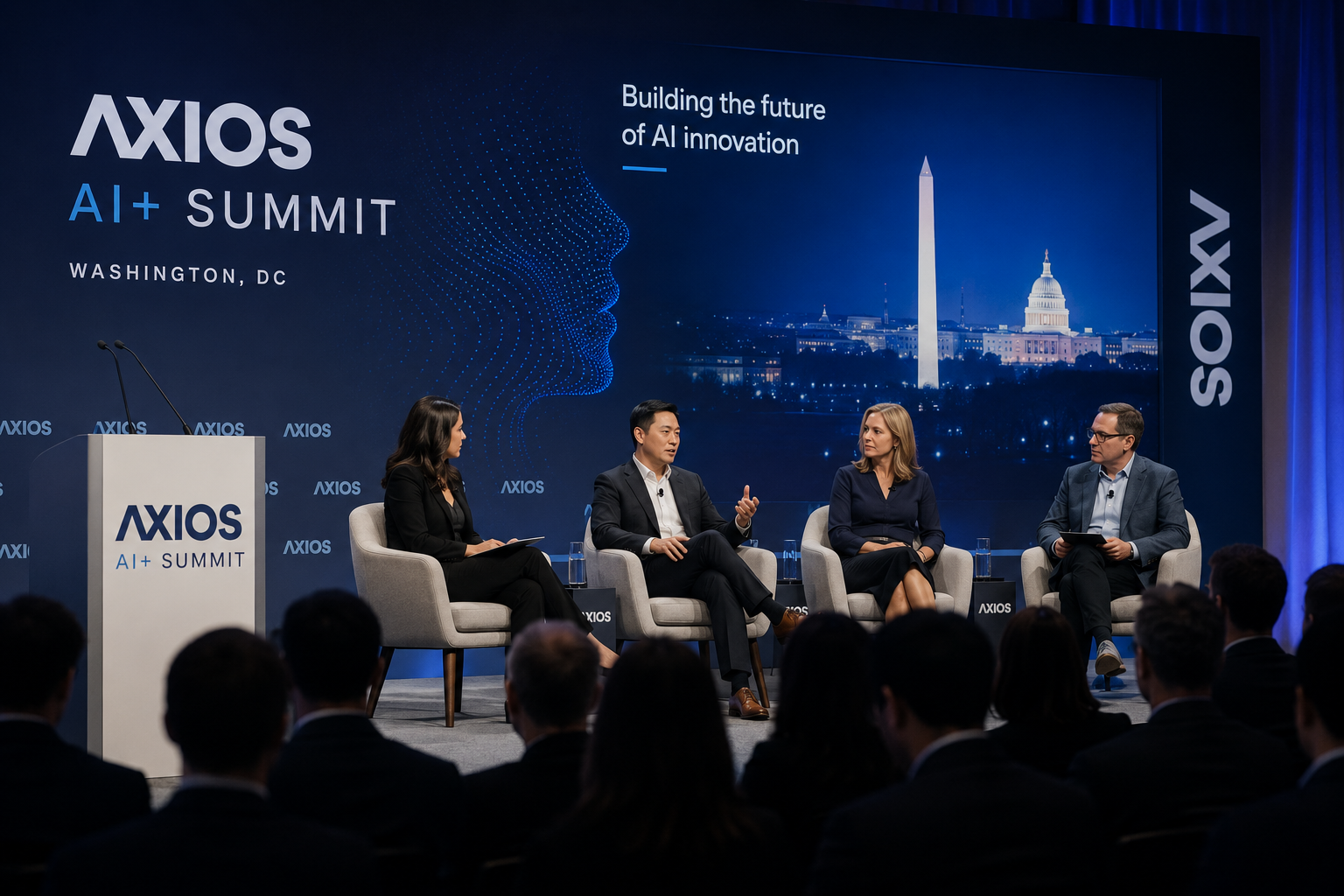
In late March, Axios brought together policymakers and AI industry leaders for its annual AI+ DC Summit. The agenda spanned healthcare, energy, defense and technology – and one theme cut across every session: proving the real-world impact of AI.
Here’s what stood out, and what it means for AI organizations.
AI is Delivering Real Results – But Not Everywhere
Go to any industry event, for any sector, and everywhere you look, you will see demos showcasing some new AI tool. Each technology promises to be the “best in class” at what it does, but when it comes to ROI and impact, things can get a little murky.
The most significant shift at this year’s Summit wasn’t a new technology announcement, but the volume of speakers who could point to measurable, real-world outcomes.
In healthcare, for example, UnitedHealth Group’s Sandeep Dadlani highlighted two telling examples: AI-listening tools that help record, transcribe, and analyze patient-doctor conversations, and AI-generated audio summaries that help nurses prepare for home visits during their rural commute.
None of this is hypothetical. It’s working and adding value. Which raises a more important question: if the tech is working, why isn’t everyone seeing the same results?
The Biggest Barrier to AI Adoption is Internal
A consistent and clear undercurrent throughout the summit was that AI’s success has very little to do with the model itself.
Adoption, training, trust, internal alignment – these are the factors that determine whether a pilot actually turns into something meaningful.
Lockheed Martin’s Craig Martell noted that this is especially true in the public sector, where AI momentum is building, but progress often stalls in process-heavy environments. Enterprises face the same friction: cultural resistance and unclear ownership can delay even the most pressing initiatives.
“We need an AI strategy” is no longer enough. Now, it’s a matter of who is using it, how, why, and what’s measurably changing because of it.
AI’s Energy Demands Are a Strategic Risk
One of the Summit’s more thought-provoking (and, interestingly, less widely discussed) conversations centered on AI’s power demands.
AI is placing extraordinary strain on energy infrastructure. Data centers are consuming massive amounts of electricity – sometimes at the scale of entire cities – creating real constraints on growth. Nuclear energy is a viable solution given its consistent, 24/7 output. At the same time, there’s growing interest in making data centers more flexible, shifting workloads to align with off-peak demand.
The takeaway: the energy dilemma is a reminder that AI doesn’t exist in a vacuum. Its dependencies (energy, infrastructure, supply chain) make it an enterprise-wide concern.
AI Risk is Evolving Faster than Organizations’ Responses
As AI evolves, so do its risks. Deepfakes and synthetic media dominated several conversations. The barrier to entry for bad actors is dropping, and traditional verification methods are no longer sufficient. The response is moving in two directions: technical, through multi-layered identity verification; and human, through media literacy. Both are necessary, but neither is moving fast enough to outpace the risks.
For communicators, this creates both a challenge and an opportunity. Organizations that get ahead of AI trust issues with clear, transparent messaging will have a significant credibility advantage.
Regulation Remains Unsettled
With the Summit held in DC, regulation was an inevitable topic on the agenda. The tension was clear: guardrails are needed, especially around security and consumer protection. But there’s also concern that overregulation—or even just inconsistent regulation across states—could slow innovation or even push it overseas.
The policy environment is also being shaped by a fundamental misunderstanding about what AI actually is and isn’t. One point was clear: the gap between policymakers and technologists needs to close—and quickly.
The Bar Has Raised
AI isn’t new. The use cases aren’t new. What’s changed is the expectation of results. There’s less patience for experimentation without outcomes. More scrutiny on ROI. More urgency to move from pilot to production—and to prove that these tools are making a difference.
That’s a higher bar. And based on the conversations at Axios, not everyone is clearing it yet. The organizations that are delivering and communicating it clearly are pulling ahead. The ones that aren’t are losing credibility fast.
That gap is where V2 works. If your organization is delivering real AI results—not just promises—let’s connect to discuss how you can stand out in this results-driven landscape. Reach out to [email protected].
Lily Young is an Account Director at V2 Communications, supporting enterprise technology clients. She leads day-to-day account operations and media relations programs, helping brands refine their messaging and earn meaningful visibility in competitive markets.
V2 Communications is an integrated communications firm and PR agency that helps healthcare, B2B and energy and climate technology companies build visibility, strengthen reputation and adapt to how audiences discover and evaluate brands in an AI-driven landscape.