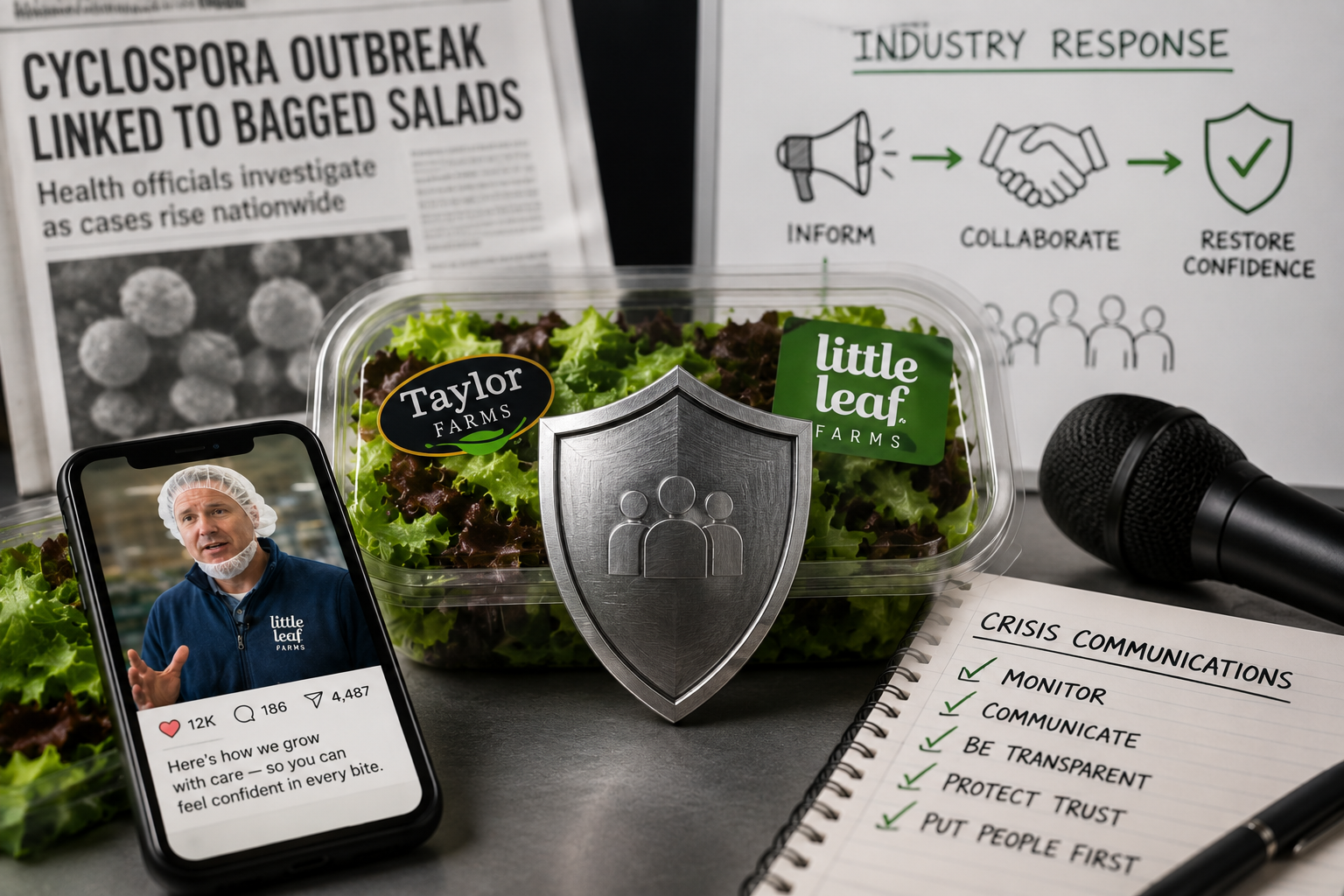
Much of the conversation surrounding the recent Cyclospora outbreak has focused on how Taylor Farms responded to being named as a potential source. But that is only one part of the lesson to be learned in crisis communications.
The bigger question is: how should an industry respond when fear and scrutiny expand far beyond the company or product directly involved?
As headlines spread and public concern intensified, the message many consumers received was not nuanced. It was not about a particular producer, supply chain or type of lettuce. It was much broader: vegetables may not be safe to eat. That kind of public reaction puts an entire industry at risk.
The challenge is not unique to the produce industry. Years ago, I built a crisis communications plan for an industry association of olive oil producers and importers. The company wanted to be prepared if a single producer were found to be marketing diluted olive oil as virgin or 100% olive oil, as consumer confidence in the entire category could suffer, particularly at a time when olive oil was still establishing itself as the cooking oil of choice in the U.S.
Massachusetts-based Little Leaf Farms offered a strong example of how a company can respond when it is not at the center of a crisis but may catch a stray consequence. I don’t know if they had a plan in place, but they acted swiftly, which was important.
The company did not wait for consumers to sort through the details themselves. It used social media—the channel where it already speaks directly to its primary audience—to explain how its products are grown and why consumers could continue to feel confident eating them.
CEO Paul Sellew played a significant role in that response. He did not appear behind a desk in a suit to deliver a formal corporate statement. He spoke from inside the company’s facilities, dressed in jeans and wearing the same protective covering required in the production environment. The presentation felt open, accessible and human.
That was especially effective because it wasn’t the kind of content consumers typically expect from the CEO on the company’s social channels. Little Leaf Farms typically uses social platforms to promote its products, share recipes and engage customers. By stepping forward personally during a moment of uncertainty, Sellew signaled that the issue was important enough to warrant his direct involvement and demonstrated that their customers were their top priority.
Little Leaf Farms’ typical Instagram posts receive about 200 likes, but their response to the outbreak has drawn more than 12,000 likes and nearly 4,500 shares. The message clearly resonated—and as a consumer, I noticed. I had never paid much attention to which packaged lettuce brands my grocery store carries, but I am now more likely to choose Little Leaf over another brand. The company not only addressed an industry crisis but also generated positive brand association in a very authentic way.
Little Leaf’s approach was not about criticizing another business or capitalizing on its difficulties. It was about recognizing that consumers had legitimate questions and likely some concerns about their product, and that silence would leave those questions and concerns unaddressed. Little Leaf Farms saw both the need and the opportunity to educate the market, protect confidence in its products and get ahead of an increasingly generalized media narrative.
That is the broader lesson for communications leaders. Most companies prepare for crises that directly involve their own operations, products or employees. Far fewer are prepared for a crisis that begins somewhere else but quickly casts doubt across an entire industry, which is common.
A cybersecurity breach at one software company can prompt customers to question every vendor that handles sensitive information. A battery fire can create concern about an entire technology. A failure involving artificial intelligence can raise questions about every business that uses it. In each case, companies need to decide whether they have credible, useful information that can help their audiences understand the issue and how their own approach differs.
That requires monitoring risks beyond the company’s own walls. It also requires knowing when to activate senior leadership, which channels to use and how to communicate without sounding defensive or opportunistic.
Not every industry crisis requires a public response from every company. But communications leaders should at least be asking the question. Little Leaf Farms did and demonstrated the value of responding early, visibly and authentically.
The central crisis communications lesson is simple: when public confidence in an entire industry is threatened, every company in that industry needs to consider its role in restoring it.
Melissa Mahoney is an executive vice president at V2 Communications, where she leads the firm’s climate and energy practice. In addition to overseeing client engagements, Melissa leads the firm’s crisis communications function. With more than 25 years of experience building and protecting tech brands, Melissa counsels organizations on integrated marketing and communications strategies that strengthen reputation, navigate complex challenges and support broader business objectives.
About V2 Communications
V2 Communications is a top PR firm for tech companies and a leading integrated communications partner focused on B2B, AI, climate and energy, and healthcare technology brands. The firm delivers integrated communications programs across earned, owned and paid media, helping companies build market leadership, increase visibility and drive measurable business results.